What Actually Happens Before a Photo Becomes a Memory?
What Actually Happens Before a Photo Becomes a Memory?
A photo finishes uploading. Somewhere later, a familiar face appears inside a story ring, ready to open. Between those moments, your application must make decisions about identity, processing, relevance, access, and delivery. An upload confirmation proves very little about whether the resulting experience will be useful or reliable. For developers evaluating a photo memories processing pipeline, the important questions begin at that boundary. Companies adding memories for cloud storage apps need to understand every transformation before selecting a SaaS provider. Following one photo through the system reveals where engineering effort accumulates, which responsibilities remain yours, and what evidence should support an integration decision.
First, the Upload Becomes an Eligible Asset
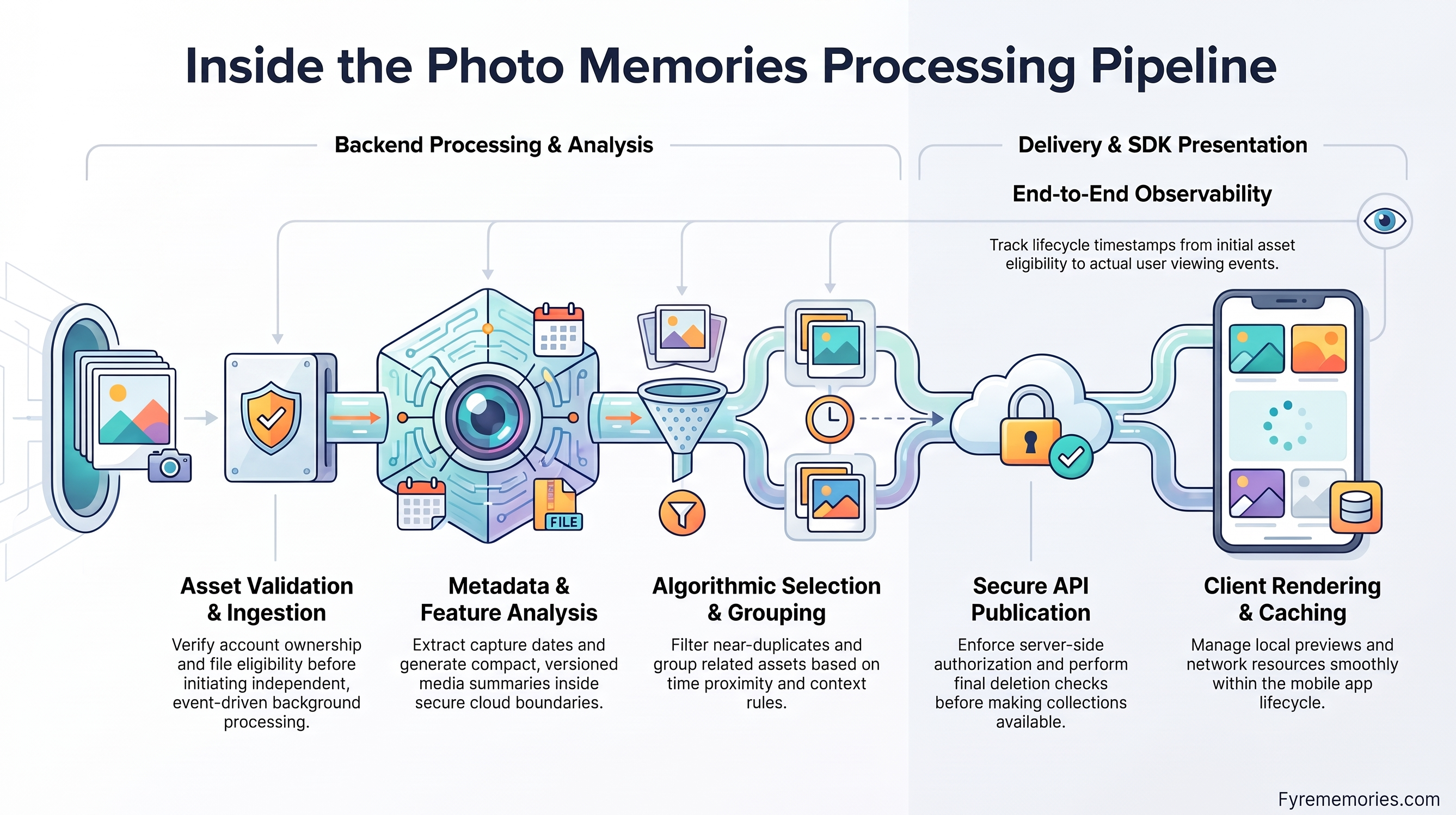
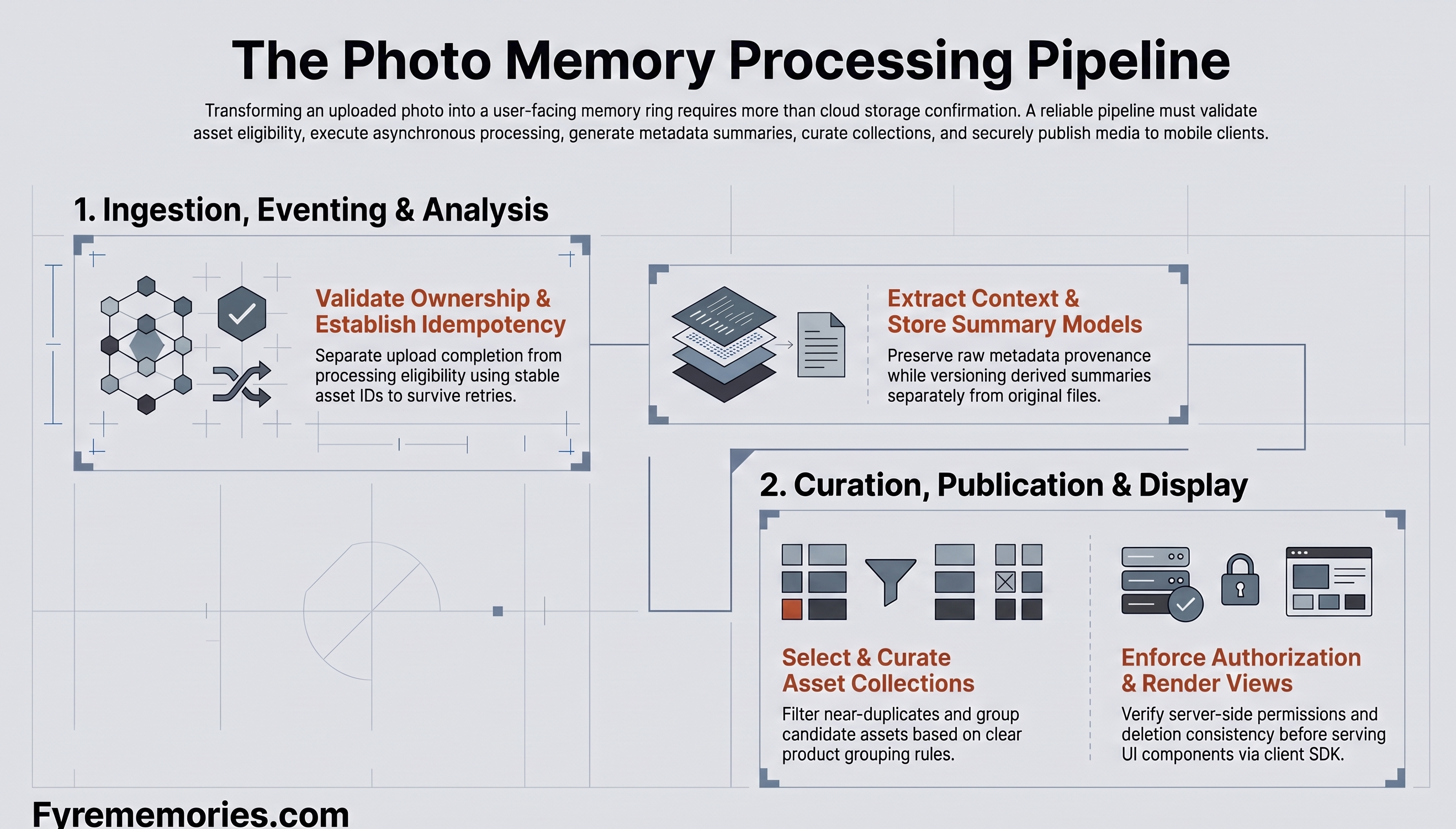
Before analysis begins, establish that the uploaded object is complete, accessible, and associated with the correct account. Treat storage completion and processing eligibility as separate states. A client notification alone should not establish ownership or prove that a worker can read the object. Your backend should verify the relevant storage reference and account relationship using trusted application records.
The photo memories processing pipeline needs a stable asset identifier that survives retries without confusing a replacement file with its predecessor. Store the object version where available, alongside the tenant, user, and processing status. Avoid making a filename your sole identity mechanism: two uploads can share a name while representing different assets. Clear identifiers also make support investigations easier when a user reports a missing memory.
For memories for cloud storage apps, eligibility should reflect product rules as well as technical readiness. Define whether newly imported files, shared albums, archived items, and unsupported formats may enter processing. A photo memories generation API should eventually expose only approved results. The mobile integration, including any memory SDK for Android apps, depends on these upstream decisions being consistent.
FAQ: Should every uploaded photo immediately enter memory processing?
No. Validate ownership, supported inputs, and the product’s inclusion rules first. A successful upload creates a stored asset; eligibility determines whether that asset should participate in a memory.
How FyreMemories Is Dealing With It
FyreMemories describes keeping the customer’s existing upload flow and processing incoming media within their cloud. Teams should confirm supported inputs and eligibility responsibilities during deployment planning. Fyrememories Blog
Next, an Event Becomes Recoverable Work
Once an asset is eligible, a notification can start background processing. The event should identify the asset and relevant context without requiring large media payloads to travel through the messaging system. A worker then retrieves the source under controlled permissions. This separation allows the upload response to complete while processing progresses independently.
Design the photo memories processing pipeline around the delivery guarantees of your actual event source. Amazon S3 documents that notifications can arrive more than once and may arrive out of order. Consumers therefore need an idempotency strategy: processing the same asset version repeatedly should not create duplicate published results. Record outcomes durably and make retries safe across worker restarts.
Historical imports complicate memories for cloud storage apps because thousands of old assets can arrive together. Separate import capacity from fresh uploads, bound concurrency, and inspect the age of waiting jobs. A responsive photo memories generation API cannot compensate for a processing backlog that never catches up. Likewise, a memory SDK for Android apps cannot display content that has not reached a usable state.
FAQ: What should happen when a processing job repeatedly fails?
Set a retry limit, retain enough diagnostic context, and route exhausted jobs for inspection. Protect the photo memories processing pipeline from repeatedly spending resources on the same unsupported or damaged input.
How FyreMemories Is Dealing With It
FyreMemories documents an event-driven processor triggered by new uploads. Its public architecture provides a starting point for discussing retry behavior, replay procedures, and backlog visibility with the implementation team. Fyrememories Blog
Metadata Gives the Photo Context
The next task is to determine what the system can reliably know about the asset. Capture time, upload time, dimensions, orientation, and available location information serve different purposes. An imported photograph taken years ago should not automatically become a recent event because it reached storage today. Preserve the distinction between source metadata and application-generated timestamps.
A photo memories processing pipeline should retain the provenance of important fields. If the capture date is missing or uncertain, record that uncertainty instead of silently presenting an inferred date as fact. Validate dimensions and decode behavior before expensive downstream work. Keep the original source intact while deriving any normalized representation required for analysis or display.
With memories for cloud storage apps, inconsistent metadata is a normal integration concern. Libraries may include screenshots, exported images, edited copies, and photographs from different devices. Decide how these inputs should behave in a test collection. A photo memories generation API needs a stable contract for dates and asset references, while a memories SDK for Android apps needs predictable display information rather than device-specific surprises.
FAQ: Can upload time replace a missing capture date?
It can serve as a documented fallback, but it represents a different event. Preserve that distinction so grouping and presentation do not imply knowledge the system does not possess.
How FyreMemories Is Dealing With It
FyreMemories documents photo and video analysis that produces summaries. Its public overview does not specify every metadata rule, so teams should validate date handling and supported formats against representative customer files. Fyrememories Blog
Analysis Produces a Usable Summary
At this stage, the system transforms media into information that later services can use. Depending on the product, analysis might involve technical quality checks, content descriptors, similarity signals, or other permitted attributes. These are architectural possibilities, not capabilities to assume from every vendor. Ask precisely which analysis is performed and which outputs become persistent records.
For a photo memories processing pipeline, version the analysis output separately from the source asset. A future model or rule change should not make old summaries impossible to interpret. Record the processor version, outcome, and relevant confidence information. Design reprocessing deliberately: applying a new method to an entire library can consume substantial resources even when no new photos arrive.
Companies operating memories for cloud storage apps should inspect the boundary between local processing and provider storage. A compact summary can still contain sensitive information, depending on its fields. Document what leaves the environment and why. The photo memories generation API and the memories SDK for Android apps are downstream consumers; their convenience does not remove the need to understand that data flow.
FAQ: Does analysis have to run again whenever a user opens the app?
Usually, reusable summaries should separate analysis from retrieval. Recompute when the asset, processing version, or relevant rules change, rather than making every viewing session repeat expensive work.
How FyreMemories Is Dealing With It
FyreMemories states that its processor reads originals inside the customer’s cloud and sends summaries downstream. Review the summary fields, access permissions, and retention arrangements before approving the integration. Fyrememories Blog
Selection Turns Candidate Photos into a Collection
Analyzing a photo does not establish that it belongs in a memory. The selection stage must decide which eligible assets belong together and whether the collection is worth showing. Possible grouping rules include time proximity or other available context, but the product must define what those rules mean and how exceptions should behave.
For memories for cloud storage apps, near-duplicate photographs expose the difference between retrieval and curation. Ten similar images might document one moment without making ten useful cards. Selection should balance coverage, repetition, and the intended viewing experience. Evaluate both large libraries and sparse accounts, because a rule that works on abundant material may produce weak results when candidates are limited.
The photo memories processing pipeline should preserve an explanation of which inputs produced each collection. This supports debugging and future removal of an asset. A photo memories generation API needs stable collection identifiers and clear readiness states. A memory SDK for Android apps should receive results that the backend has already judged eligible, with intentional handling when no suitable collection exists.
FAQ: Should a memory system always generate something for every user?
No. An empty result can be appropriate when eligible material is insufficient. For memories for cloud storage apps, forcing weak collections can undermine the usefulness of the experience.
How FyreMemories Is Dealing With It
FyreMemories describes an engine that builds memories for individual users from indexed summaries. Teams should request examples to assess selection quality and clarify available controls rather than assume a particular grouping algorithm. Fyrememories Blog
Publication Requires an Authorized Retrieval Contract
Once a collection is ready, publishing it means making a consistent representation available to the correct user. Define what readiness guarantees: valid asset references, required presentation information, and an agreed ordering. Avoid publishing half-complete records that force the client to guess whether missing fields indicate temporary processing or a permanent failure.
A photo memories generation API must enforce authorization on the server. Supplying a user identifier from a client is not proof that the requester may access that user’s content. Keep tenant and account checks explicit, including for asset delivery. Review token expiry, permission changes, and how cached responses behave when access is revoked.
In memories for cloud storage apps, deletion can race with processing. A worker might finish analyzing a photo after the user removes it. The photo memories processing pipeline therefore needs a final eligibility check or equivalent consistency mechanism before publication. A memory SDK for Android apps also needs a documented refresh strategy so removed results do not remain visible indefinitely.
Pagination and versioning deserve attention during evaluation. Ask whether the service returns an entire collection, a window of results, or a versioned snapshot. Clarify how a client should respond when results change during browsing. The photo memories generation API should make these behaviors predictable enough to test, especially when users alternate between devices or resume an interrupted session.
FAQ: Is clearing the mobile cache sufficient after a photo is deleted?
No. Deletion must address server records, derived results, delivery access, and relevant caches. Establish which system owns each step and how completion is verified across the integrated service.
How FyreMemories Is Dealing With It
FyreMemories exposes a Memories API for SDK retrieval. Its Android documentation describes per-user state and sign-out cleanup. Teams should additionally verify backend authorization and deletion behavior for their deployment. Fyrememories Blog
The Device Prepares the Memory for Viewing
The collection has reached the application, but the user still needs a responsive experience. The client must prepare previews, obtain display assets, manage local resources, and handle navigation. Even a photo-only collection can feel slow if thumbnail requests compete, image decoding blocks interaction, or content is repeatedly fetched during screen transitions.
Evaluate a memories SDK for Android apps with realistic media sizes and devices. Confirm how it initializes after authentication, behaves when the app enters the background, and releases resources when the feed closes. Include account switching and missing content in the test plan. A successful demonstration on one device does not establish reliable behavior across your supported application environments.
The photo memories generation API should supply the information needed to render without unnecessary follow-up requests. Meanwhile, the photo memories processing pipeline must make any required display derivatives available before advertising them as ready. For memories for cloud storage apps, these contracts connect backend correctness with the moment the user actually sees something worthwhile.
Caching and preloading should have explicit limits. Preparing likely next content can reduce waiting, but fetching an entire library wastes resources when the user leaves quickly. Test startup delay, downloaded bytes, cache growth, and recovery after network interruptions together. A memory SDK for Android apps should offer an integration model whose tradeoffs your team can measure.
FAQ: Does a headless integration remove the need for frontend engineering?
No. It provides data access while your team owns the presentation and interaction. Choose a memories SDK for Android apps with standard components when those components satisfy your product requirements.
How FyreMemories Is Dealing With It
FyreMemories offers carousel, full-screen, and headless options. Its SDK documents caching and customization controls. These give developers concrete integration choices to evaluate against their application’s layout and lifecycle requirements. Fyrememories Blog
Measurement Determines Whether the Pipeline Works
Before calling the feature complete, connect operational evidence with actual viewing behavior. Track when an asset becomes eligible, when processing finishes, when a collection is published, and when it becomes visible. These timestamps reveal whether waiting originates in workers, publication, retrieval, or the client instead of treating every delay as the same problem.
A photo memories processing pipeline needs more than an overall success rate. Review failed jobs, retry volume, backlog age, and processing cost across different library profiles. A photo memories generation API needs measurements for authorization failures, response behavior, and result freshness. Establish practical service expectations and escalation ownership before a customer incident crosses company boundaries.
For memories for cloud storage apps, engagement should be tested against an explicit product hypothesis. Viewing a collection does not automatically prove better retention. Compare return behavior over a suitable period and inspect whether adoption differs across user groups. Assess the memories SDK for Android apps alongside the backend so analytics events correspond to actual viewing rather than merely successful requests.
Run a representative pilot before committing to SaaS. Include historical imports, sparse libraries, duplicate events, interrupted sessions, and deletion during processing. Ask how the provider supports investigation when the photo memories generation API returns unexpected results. Document the work your team still owns, including customer-cloud costs, integration maintenance, and support coordination.
Compare providers using the same acceptance tests. For memories for cloud storage apps, include assets with uncertain dates and accounts that change permissions during the pilot. Exercise the photo memories generation API after those changes and observe the resulting client behavior. Review the memories SDK for Android apps with both engineering and product stakeholders present. Agree who approves launch, which issues block release, and what evidence must be retained for future regression checks. This makes procurement an accountable, documented engineering decision.
FAQ: What should a technical SaaS evaluation prove before launch?
It should demonstrate that the photo memories processing pipeline handles agreed workloads and failures, that access boundaries hold, and that the team can diagnose issues without relying on a polished demo.
How FyreMemories Is Dealing With It
FyreMemories documents engagement analytics and an Android analytics integration surface. Combine those capabilities with a deployment review covering operational visibility, service responsibilities, and the acceptance criteria your own engineers require. Fyrememories Blog
Conclusion
A photo becomes a memory through a sequence of accountable decisions: eligibility, processing, interpretation, selection, publication, and presentation. Each transition deserves an owner and a testable contract. The strongest photo memories processing pipeline makes failures visible and keeps changing permissions connected to the results users receive.
For companies delivering memories for cloud storage apps, choosing SaaS should simplify that operating model while preserving the controls the product needs. Evaluate the photo memories generation API and the memories SDK for Android apps as connected parts of the same experience. Explore FyreMemories with representative assets, concrete failure scenarios, and clear success criteria, so the first visible memory is backed by infrastructure your team understands.
Ship the feature this week, not next quarter.
FyreMemories is a production-ready memories SDK for Android. One dependency, one afternoon to integrate.