The Hidden Engineering Behind Every “Remember This?” Moment
The Hidden Engineering Behind Every “Remember This?” Moment
The product request sounds modest: show people a few meaningful photos, add a video recap, and give them a reason to return. The prototype looks convincing by Friday. Then an imported library overwhelms processing, a video stalls on mobile data, and a deleted photo reappears inside a cached collection. Suddenly, your memories feature involves queues, identity, media delivery, and incident response. For Android developers, CTOs, and founders evaluating a photo memories SDK for Android apps, the real decision is how much of that machinery to build, operate, and keep aligned with the product experience customers expect.
1. The Visible Problem: A Simple Feed Becomes a Distributed Feature
Users experience memories as a single interaction. They tap a story ring and expect relevant content to appear quickly. They do not distinguish between an upload service, a processing worker, a collection API, and a device cache. When any component fails, the entire feature feels unreliable.
Product managers encounter a different symptom: the scope keeps expanding. A carousel needs thumbnails and viewed states. A video feed needs playback controls, lifecycle handling, and recovery after interruptions. Personalization needs usable metadata, selection rules, and enough eligible material. Deletion introduces coordination across every representation of the original asset.
The first architectural mistake is treating these requirements as independent tickets. They form a connected data lifecycle. A collection generated successfully yesterday may be invalid today because its permissions changed. A responsive API can still deliver a poor experience when media takes several seconds to start. A beautiful interface cannot compensate for irrelevant selections.
Sparse libraries deserve particular attention. New users may have only a handful of uploads, while established accounts can contain years of duplicates, screenshots, and edited exports. Generating something for everyone is not necessarily a useful objective. Sometimes the correct result is an intentional empty state rather than a weak collection.
Android adds lifecycle complexity to this already distributed system. Playback must respond appropriately when an activity pauses, a screen rotates, or another application takes audio focus. Account switching must also prevent previous results from appearing during a fresh session. Comparable concerns exist on iOS, although the platform APIs and implementation details differ.
For engineering leaders, the useful starting point is a responsibility map. Identify who owns eligibility, processing, publication, authorization, playback, and support. That exercise exposes the difference between a working prototype and a feature that can survive growth without diverting the core application team into permanent media infrastructure maintenance. Fyrememories Blogs
2. The Architecture: From Uploaded Asset to Reliable Playback
Make processing recoverable before making it fast
A photo memories processing pipeline should begin with a durable asset identity. Associate the object with its account, record its version where available, and verify eligibility before analysis. Upload completion establishes that storage accepts a file; it does not establish that a memory is ready.
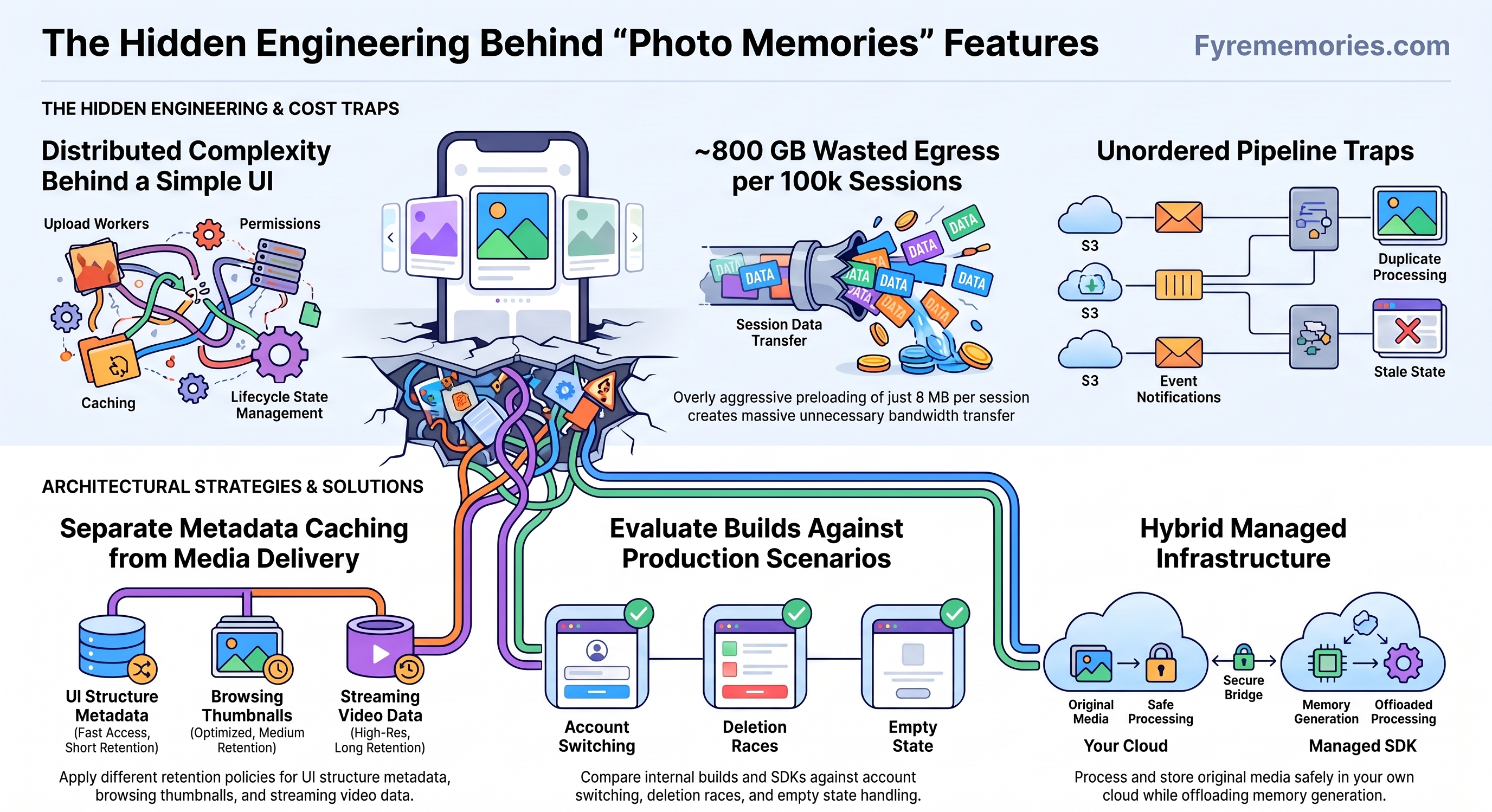
Use events to schedule background work rather than blocking the upload response on media analysis. Event consumers must respect their source’s delivery guarantees. Amazon S3 notifications, for example, can arrive more than once and do not guarantee event ordering. [1] Processing should therefore tolerate replay without publishing duplicate results.
An application-owned job might carry the following fields. This is an illustrative internal payload, not a FyreMemories endpoint or documented request schema:
{
"tenantId": "tenant_42",
"assetId": "asset_918",
"sourceVersion": "v3",
"processorVersion": "analysis_2",
"jobKey": "tenant_42:asset_918:v3:analysis_2"
}
Use the job key to identify repeated work, claim jobs atomically, and persist the outcome. Deduplication must extend to publication: a worker can crash after writing output but before acknowledging its event. Retrying should recover the existing result or replace it safely.
Historical imports need separate capacity planning. A large archive can consume workers intended for recent uploads. Bound concurrency, apply retry backoff, and monitor the oldest waiting job. Separate workload lanes where necessary, with explicit limits that protect interactive expectations while imports progress.
Give the pipeline a shared vocabulary for states such as pending, processing, ready, failed, and removed. A client should not have to infer readiness from missing fields. Include a collection revision in your own response model so consumers can recognize changes without confusing an updated result with a new memory.
Observability should follow the same boundaries. Propagate correlation identifiers between processing and publication, then link retrieval failures to the relevant collection. Avoid logging personal media, access tokens, or signed delivery URLs. Record enough structured context to distinguish unsupported inputs from temporary dependency failures. This makes debugging faster and reduces the temptation to reproduce every incident by manually opening customer content. It also gives support teams a concrete starting point during escalation.
Keep source access narrow and derived data traceable
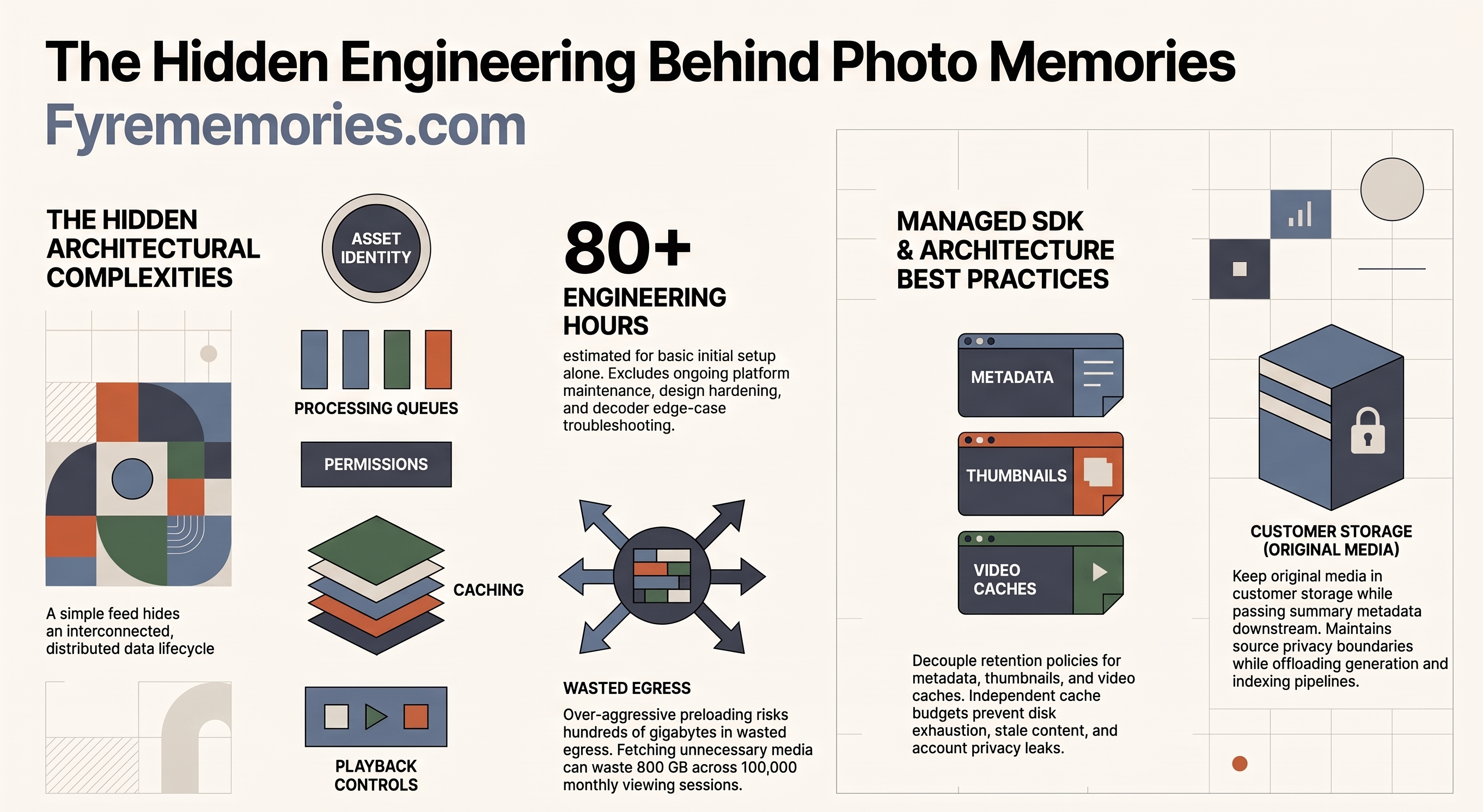
Processing inside the customer’s cloud can preserve the existing storage arrangement and avoid copying originals into another provider’s storage. However, location alone does not establish a complete privacy boundary. Document where summaries, derived media, collection records, analytics, and delivery caches reside.
A read-only storage permission should grant only the source access the processor requires. Processing jobs may still create summaries or derived records elsewhere, so review their outputs and destinations separately. Keep permission management, runtime deployment, and operational logging visible to the responsible engineering team.
Preserve capture time separately from upload time. An old photograph imported today should not automatically become a recent event. Record metadata provenance and processing versions so future changes remain explainable. Link each generated collection to its source assets, enabling targeted invalidation when content becomes ineligible.
Deletion also creates a race: a worker may finish after the source has been removed. A tombstone or revision check can prevent stale work from publishing, provided that publication coordinates with the current eligibility state. The server must enforce authorization independently of any user identifier supplied by the client.
Separate metadata caching from media delivery
A fast feed usually combines several caches with different purposes. Collection metadata helps the interface render its structure. Thumbnails support browsing. Video data supports playback. Giving all three the same retention policy makes it harder to control disk use, freshness, and account isolation.
For metadata, consider a bounded freshness window with background revalidation where your access model allows it. Sensitive permission changes may require stricter invalidation. Use asset versions to distinguish updated media from older cached representations, and include account scope wherever cache entries could otherwise overlap.
Measure API response time separately from tap-to-first-frame latency. The latter includes media access, network transfer, player preparation, and decoding. Track cold and warm sessions independently; a warm-cache average can hide a poor first encounter.
Preloading can reduce visible waiting, but it shifts work earlier rather than eliminating it. Fetching the next likely video may be useful. Fetching several complete videos for someone who leaves immediately wastes transfer and storage. Adapt budgets to connectivity, user preferences, device constraints, and observed viewing behavior.
Adaptive bitrate streaming is a separate architectural choice. It requires multiple encoded renditions and a supported manifest format, such as HLS or DASH, so the player can select an appropriate stream. A single MP4 with next-item prefetch is not equivalent. Confirm the provider’s actual delivery formats before assuming adaptive streaming is included.
The SDK-versus-custom-UI decision follows the same principle. Standard components reduce presentation work; a headless integration preserves control but returns layout, accessibility, interaction, and lifecycle responsibilities to your team. Choose based on the experience you need to own, not simply the amount of code in the initial demonstration. Fyrememories Blogs
3. The Business Impact: Engineering Scope Becomes Operating Cost
The cost of memories infrastructure is rarely represented by one subscription line. It includes integration work, processing compute, source reads, media delivery, observability, support, and ongoing compatibility testing. An inexpensive component can become costly if it leaves the surrounding operating model undefined.
Consider an illustrative planning estimate, not a vendor quote or industry benchmark. If two engineers each spend 20 hours integrating playback and presentation, another engineer spends 24 hours connecting backend events, and validation requires 16 hours, the initial allocation is 80 engineering hours. It excludes design, production hardening, and future maintenance.
The purpose of that estimate is to make scope visible. Replace every assumption with your own backlog and staffing rates. Compare an SDK and an internal build against the same acceptance criteria, including account transitions, empty libraries, failures, and deletion. Comparing a vendor’s production integration with an internal prototype produces misleading economics.
Bandwidth creates another concrete trade-off. Suppose 100,000 monthly viewing sessions each download an unnecessary 8 MB through overly aggressive preloading. That amounts to roughly 800 GB of additional transfer in decimal units. Whether it becomes billable egress depends on the delivery path and commercial agreements, but the wasted bytes remain observable.
Set performance targets within a defined test environment. For example, a team could propose p95 tap-to-first-frame below 1.5 seconds on a specified device and network profile. This is an illustrative acceptance target, not a FyreMemories benchmark. Pair it with downloaded bytes per session and rebuffering measurements so faster startup does not conceal excessive resource consumption.
Retention needs similar discipline. Track how many eligible users see the entry point, open a collection, watch meaningfully, and return later. Completion rate can identify viewing behavior, but it cannot independently prove incremental retention. Users with richer libraries may already be more engaged before the feature appears.
A controlled rollout helps separate correlation from impact. Define the comparison group, observation window, and guardrails before launch. Include crash rates, startup performance, and support contacts alongside engagement. A feature that increases viewing while destabilizing the main application may deliver little overall value.
Maintenance is another recurring budget item. Android platform changes, dependency conflicts, decoder behavior, and authentication updates can require investigation long after the launch sprint. Establish who reproduces bugs, who supplies fixes, and how your team validates upgrades. A vendor relationship reduces uncertainty only when escalation paths and supported configurations are clear.
Time-to-market matters because delayed learning also has a cost. A suitable SDK can bring the first measurable release forward by reducing implementation scope. The strategic benefit is strongest when your team can spend that recovered time on differentiation, customer feedback, and product experiments instead of repeatedly maintaining generic playback infrastructure. Fyrememories Blogs
4. How FyreMemories Addresses This
FyreMemories combines a native Android memory experience with a processing platform. Its documented architecture keeps originals in the customer’s cloud, processes incoming uploads there, and passes summaries downstream for indexing and memory generation. Teams can retain their existing upload flow while evaluating a managed generation layer.
The source boundary is explicit: the processor requires read access to customer storage. Your deployment review should still establish runtime responsibilities, summary fields, retention, and deletion behavior. Keeping original files in place simplifies one part of integration; the complete operating agreement still deserves engineering scrutiny.
On Android, FyreMemories offers a story carousel, a full-screen feed, and a headless repository. These support different integration depths. Standard surfaces can reduce custom interface work, while repository access lets teams build a distinct presentation around the returned data.
Initialize after authentication, then bind the experience
The public SDK documentation requires a signed-in Firebase user before initialization. Place initialization in your authenticated application flow, with a clear owner, rather than assuming a restored user is available during application startup. The following excerpt assumes dependency setup, imports, and the host authentication flow already exist: [2]
// Run after the host app confirms Firebase authentication.
if (FirebaseAuth.getInstance().currentUser != null) {
FyreMemories.init(context = applicationContext)
}
After initialization, an Activity containing the carousel view can bind it to the current user. The layout must already declare the view with the matching identifier; this excerpt shows the binding step rather than a complete Activity: [2]
val userId = FyreMemories.currentUserId()
if (userId != null) {
val carousel =
findViewById<MemoriesCarouselView>(R.id.memoriesCarousel)
carousel.bind(lifecycleOwner = this, userId = userId)
}
These small integration points should sit inside a larger lifecycle plan. Decide how the host screen handles unavailable content, where navigation opens the feed, and how authentication transitions stop old requests and presentation. Documented SDK methods reduce plumbing, but they do not replace application-level acceptance testing.
Choose defaults deliberately and measure the result
FyreMemories documents separate thumbnail and video cache budgets, next-video prefetch controls, and per-user state. Its sign-out guidance includes a cleanup method. Review these controls against your expected session length, device storage constraints, and account-switching behavior before selecting production settings.
Built-in engagement analytics and integration hooks can reduce instrumentation work. They give product teams a starting point for observing viewing behavior, while engineering teams should connect those signals with application reliability and delivery measurements. Confirm event definitions before combining SDK analytics with your existing reporting.
For a photo memories SDK for Android apps, the practical evaluation is an integrated pilot. Use representative libraries, mixed media, historical imports, and unreliable networks. Verify how the feed behaves after permissions change, when no memories exist, and when a user leaves during preloading.
Make the pilot reviewable by recording the environment and expected outcome for each scenario. For a large import, capture queue age and time until the first usable collection. For interrupted viewing, record recovery behavior and repeated downloads. For account changes, verify that previous content disappears before the next user’s experience becomes available.
Also plan how you will reverse a rollout. Your application should be able to hide the entry point without affecting uploads or core navigation. Decide how a disabled feature handles pending requests and cached presentation. This limits the impact of an integration problem while your team investigates with the provider.
The public material currently centers on native Android integration. Teams planning iOS should confirm availability, feature parity, and delivery commitments directly rather than assuming a matching SDK. The architectural principles transfer across platforms, but implementation support is a separate procurement question.
FyreMemories is a fit to investigate when your team wants a managed memory layer and reusable presentation components while retaining its existing source storage. The buying decision should rest on measured integration effort, verified behavior, and an agreed division of responsibilities. Fyrememories Blogs
5. Frequently Asked Questions
Should we build a photo memories feature ourselves or use an SDK?
Build internally when owning selection, processing, and playback behavior is central to your differentiation and you can fund their ongoing operation. Evaluate an SDK when reusable infrastructure can shorten delivery while preserving required controls; compare both options against the same workload and failure scenarios.
Does a memory SDK reduce cloud costs automatically?
No. Caching and bounded preloading can reduce repeated downloads, but processing, derived assets, and speculative transfer still consume resources. Measure the full delivery path and include your own cloud charges alongside provider fees before concluding that an integration lowers costs.
A convincing “Remember this?” moment is the visible result of reliable processing, useful selection, careful access control, and efficient playback. Your next step is to test those responsibilities together. Explore the FyreMemories SDK documentation and platform features, then run an Android integration pilot with your own assets, authentication flow, and measurable acceptance criteria.
Ship the feature this week, not next quarter.
FyreMemories is a production-ready memories SDK for Android. One dependency, one afternoon to integrate.